

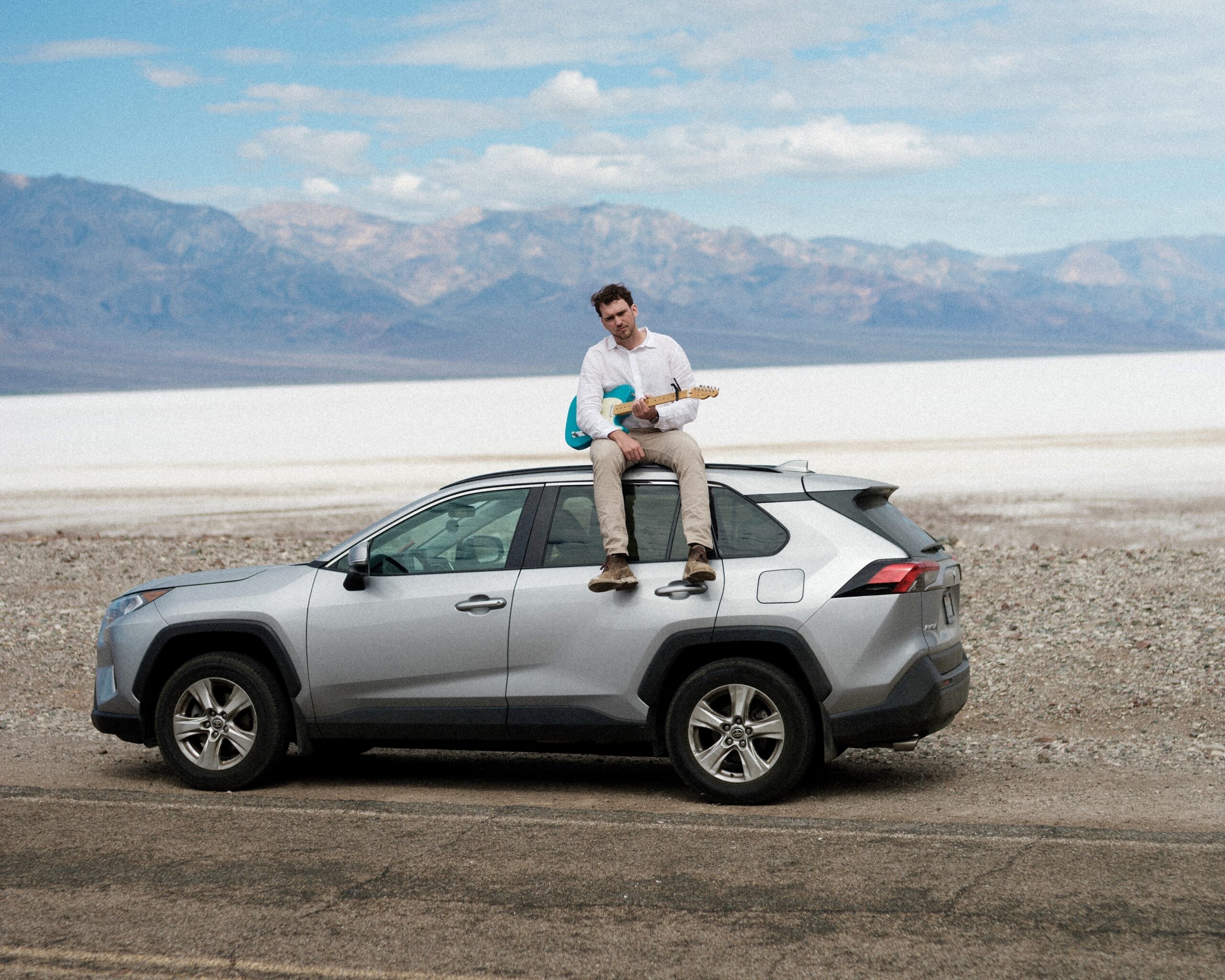
With “Crashland” setting the tone for his upcoming album Safer at a Distance, Cade Hoppe is entering a new chapter. One shaped by experimentation, vulnerability, and a growing confidence in the space between producing for others and stepping fully into his own voice.
Taylor w/ Off Record Media (ORM): What sparked your passions to start playing or making music?
Cade Hoppe (CH): My mom is a very gifted writer and I think that that’s part of the reason why she went into law. And then my dad is very good at math, you know, a good accountant. But he’s also musical and played sax and piano growing up. It’s really as I draw the comparison with my dad. Something that’s occurred to me in real time, is that music is so mathematical. I think it made sense to him and that’s why he played by ear. I’d be interested to actually talk to him about that. I don’t know how he thinks about music, but my point is that I have (music) in my blood. I had writing and music there, but life’s story about how things should unfold differs from my final path. Which is something that has no road map. Everyone kind of finds their success – if they’re lucky enough to find success. They find it in a different way.
CH: Growing up I kind of thought that people have a passion that they suppress. You know? They do so in favor of something practical. So when I kind of figured out, in my very early adult life, that not everyone actually has a passion; and I was at a business school, where people were desperately trying to find their passion for when they get out of school then suddenly they’re working at a bank and they don’t know what they’re gonna do to let loose. You know, I had friends in painting classes like “huh? Is this my passion?”. And I think that was very affecting. I was like “wow, I have this thing (music) that I would kind of be an idiot to not do” and it made me more and more sad the more I went without it. With my schedule being filled with a lot of academics and athletics at a Division Three school where it’s not rewarding, really. It was just like this hurricane of things, and I found that eye of the storm for me and it was music. The pandemic gave me the opportunity to do that.
CH: Music was always in my life and the very first concert that I went to was a Ben Folds concert. I don’t know if you are familiar, but he did a San Francisco Symphony concert where he played all of his stuff. He had charted for the orchestra to accompany him. I was 14 when I went and it was a two-hour drive to San Francisco from Sacramento. My dad took me, he finally thought that I was old enough to go because Ben Folds is kind of known to curse quite a bit. So we went and I just remember I voice memoed the whole concert. I don’t know if that’s like, you know, super acceptable, but I remember on the two-hour drive back home to Sacramento, I listened to the concert over again and it was the most magical thing ever. A week after the concert, I wrote my first song. I tried to write songs before, but it’s so elusive. Like, you don’t know how to do it until you’ve done it. Then I wrote a song that was a total ripoff of a Ben Folds song, but that’s how you start! So yeah, it was always “cooking” and I realized “oh, this is something I can go do”. Even if it’s a stupid idea and AI is gonna come for us like, you know? You have to, you have to do it.

ORM: You took a huge leap of faith, a life pivot if you will. How did walking away from NYU change the way you approach your work?
CH: I’m based in LA, been here for a year now. My partner and I are actually engaged, she’s my fiance! She is an artist and I produce all of her stuff and write her stuff with her. Her name is Maddie Regent. We moved here together and lived in New York. I lived there for seven years. She was there for nine or ten years and that’s kind of where we both started music. We met because I started music when the pandemic hit, so in 2020. I took a gap year from school – I was studying finance and playing basketball at NYU. I took the world stopping as my chance to kind of flip my life on its head. A lot of people kind of have a similar experience of that epiphany of; “okay, this is actually what I want to do with my life and this is a perfect moment to chase that instead”. Ever since, I’ve just been ramping up to the iteration that I’m in now; which is freelance indie music production. So, that’s why we moved to LA or part of the reason. Just to pursue music in general and be around a lot of people that are pursuing that here. It also gives me more opportunity to be around artists that are in need of producers.
ORM: Any specific artists or life experiences that helped shape your sound? Would you say Ben Folds was a huge influence?
CH: I mean I used to sleep with my headphones on all night long and have his whole discography playing. Which included all of these live versions of his songs as well. I would have like 300 songs on shuffle and so they kind of seeped into my subconscious, I was pretty obsessed. I would have been worried about myself – if I had met myself at 12 or 13. But yes, I listened to a lot of his stuff. He made piano rock cool. He was in this 90s piano rock trio – just a piano, bass guitar, and drums. And they were called the Ben Folds Five, with three members – he thought he was hilarious. He’s theatrical, but within the confines of 90s punk rock.
CH: The Fray. I was very inspired by them and they actually opened for him (Ben Folds) in like 2005 when they were like very first starting out. Ben Folds also opened for John Mayer at some point in the 2000s. Coldplay was a huge influence for me, as well as The Killers. I had the first Kelly Clarkson and Avril Lavigne albums on CD too. It was like a myriad of influences in my growing up. I grew up on Queen’s greatest hits, too and then it kind of turned into Taylor Swift. She was definitely a huge influence as far as pop songwriting and singer-songwriter vibes. The band, Fun, gave way to Jack Antonoff and Bleachers then to Lorde. Like Jack Antonoff is my guy. He’s my production icon. You know, for the past decade that’s kind of been who I was chasing in one way or another. To be honest, Ben Folds is maybe not someone that people would think of when they listen to my stuff now. But if you heard the album that I’ve since taken down from Spotify that my stepbrother and I did, you’d understand…totally just trying to do the Benfolds five thing.
ORM: Can you walk me through your typical creative process?
CH: For a very long time I was convinced that I’ve never written a song, I’d never finished a song, or written one fully without wearing my glasses. It became kind of a superstition where I would get writer’s block or something in the middle of writing a song, then I’d realize I didn’t have my glasses on. I was wearing my contacts and I was like, “oh, that’s why”. I mean that’s kind of a sillier part of my processes. Now, I sit down at a piano or guitar and just write a song. “Crashland” I wrote on an acoustic guitar.
ORM: Has knowing how to produce helped you be a better writer/musician?
CH: Production became part of my songwriting process. I grew up playing saxophone, piano, and then I picked up guitar along the way. In the past few years, I bought a violin. Which you know doesn’t mean that I can play it that well, but I play it on a lot of instruments for production purposes. I can use it as a tool and I had already laid a lot of the groundwork for being a producer. Especially like a bedroom producer where you are playing all the parts yourself. Near the end of writing this record, I was becoming more of my own producer. For a long time I had to learn, get better, and I got into production by hiring my producer. A friend of mine, Harper James. We made this new record together. There are a few songs that I produced on my own and he mixed. I guess seven out of the eleven songs and then I produced four on my own followed by Harper’s mixing.
ORM: Let’s dive into your new single “Crashland”, that’s out now everywhere. It’s built around warm grooves and shimmering guitars, tell me its backstory.
CH: I feel like with a lot of songs I know a little bit more what they’re about as I’m writing it, if that makes sense. I’m very driven by first lines and If I don’t have a good first line, I don’t have anything, you know. I write songs chronologically. The verse leads into the pre-chorus, leads into the chorus, and then once I have that, everything becomes a lot easier. That way I know what the story is, the way a chorus contextualizes a verse. Like this is happening, but the course says what it means or says like the underlying emotion.
CH: At least that’s the way that I look at it. So with this one, I had that idea for the first line; “We got high under starry skies, but you kissed me back and you don’t know why”… it had something there that was, I don’t know, compelling to me. So then I kind of kept pulling at that thread and once I got to the chorus, that’s when I figured out that it’s a song about being all in on “this idea” even though you know it’s destined for failure potentially. You’re free falling through the air and see the ground coming at you like a thousand miles an hour, but you’re still gonna soak up every last second of it. So it’s not like this was a turning point in my songwriting where I,for a long time, felt like any good song had to be this ultra confessional. Just pieces of my soul, almost like ‘too much information’ or something.
CH: …Just painfully honest pieces of my life into songs and I think that can be true. There are great songs that without a shadow of a doubt this happened to this person. “ Crashland” was kind of like “oh!” I can write a story that is true. We aren’t actually getting high under starry skies”, you know what I mean? It’s a little bit of an exercise and letting go. Because how many confessional-like, raw honest things can you write?
ORM: “Crashland” is the third single you’re releasing from your upcoming album, Safer at a Distance, that’s coming this fall. How would you describe the sonic world of the album as a whole?
CH: Yeah, I think cinematic is a great word. It definitely was very important to me that that’s how the whole record comes across. To me, it’s a road trip album. When I think of the two videos for “Still Turn This Around” and “Lake Michigan” they were a one shot video in a car (“Still Turn This Around”) and a road trip concept (“Lake Michigan”).. It’s very literally about a road trip. Throughout the album, it’s a theme I continue to explore. It’s ethereal but grounded – it’s kind of how I experience a road trip, it’s almost like floating through outer space. It is like everything within the confines of your car is true and real. It’s tangible. And on the outside, everything is just a blur. I think when listening to the album I want people to feel exactly where they are and on the outside, everything is just rushing past you.
ORM: What did this record let you say that might have remained unspoken in your past work?
CH: Yeah, thematically, this album is more of a reckoning with the decisions I made in 2020 to pursue this. It’s kind of like, I don’t know if you’re familiar with the Expert Confidence Gap, the Dunning-Kruger? When you know a little about something, it shoots up – they call it “Peakmount Stupid”. And when you get just over the hump, it shoots down to the “Valley of Despair” then slowly, overtime, goes up on the “Slope of Enlightenment”. For me I’ve really experienced that throughout life, not only my music career, and I’m over “Mount Stupid”. I’m in this period of reckoning where I have no idea how long I’ve been here. There’s no metric to say exactly where I am on the slope or where I’m going, and I don’t know how much farther I have to go on this unknown destination. So, I’d say I’ve been able to speak on what I’ve left behind and the people that aren’t in my life’s orbit anymore. And it’s much more about everything and nothing at all. It’s about what this strange “trip” is.
ORM: Bonus Question: What’s your perfect 10/10 record?
CH: Lana Del Rey’s ‘Norman Fucking Rockwell!’. It’s a 10 out of 10 – more like an 11 out of 10! But more recently the record ‘SAYA’, by Saya Grey. She’s on Dirty Hit, which actually, The 1975’s are on that label. When I listened to that record for the first time, I was so moved. Honestly, I was mad that I couldn’t make it. I’m not as familiar with her other work, but that record…yeah. It’s so good. And finally, ‘Viva La Vida’. It’s funny because the title track from that record is the famous one. It’s what makes it so popular, but so many producers talk about how it’s their favorite producer’s album. Brain Eno is one of the producers on it!

Check out Cade Hoppe’s new single, “Crashland”, available now on streaming platforms. And keep an eye out for his upcoming album, Safer at a Distance coming this fall.

I'm a music writer, reviewer, and enthusiast based in Chicago, IL. Music has always been my passion, and I enjoy all genres of live music. In addition to my love for the art, I also collect vinyl, create music content, and run a music lovers club under the name "MaraschinoMix". In my free time, I curate playlists, share music recommendations, and enjoy staying active with running and yoga.
