

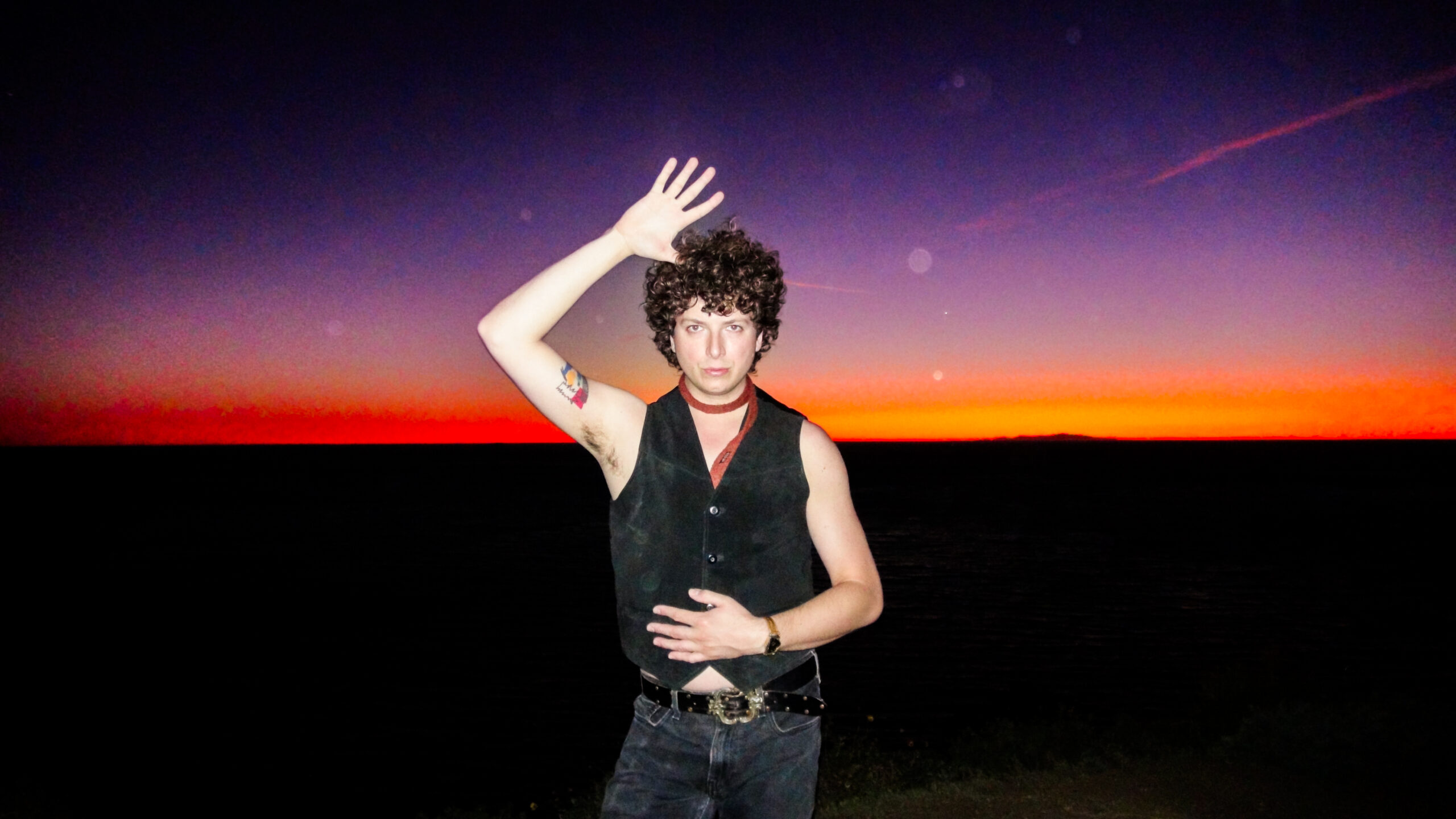
Songwriter, guitarist, DJ, and producer Nick Kivlen is stepping into the spotlight, solo, with the debut of his first single, “Starlight.” Rooted in intention, thought, and care, his sound comes to life on his debut solo record, Addicted to the Sunset.
ORB: What made now the right moment to step out with a debut solo album?
Nick Kivlen (NK): Well, this year has been in the calendar, as far as Sunflower Bean stuff for a while, because Julia (lead singer of Sunflower Bean) has been working on her solo album, which came out in April. And I think all three of us are branching out into different avenues. I really wanted to get involved in the music scene in L.A., because I write and produce a bunch of younger artists out here. I really want to have that outlet and get back to playing locally and really connecting with other people and meeting musicians. I think the social aspect of wanting to share on a very community-like “grassroots” level is something that I’ve really missed over the last 10 years since Sunflower Bean left our DIY scene in New York and branched out. Once that happens, everything gets more serious. You can’t just play shows, and you have a label, an agent, and all this stuff that is helping you grow on a wider level. But on a local level, you kind of become more disconnected. So I just really wanted to have fun again with a new project, branch out in L.A., and have a more community-driven music experience.
ORB: You grew up in New York and came up through Brooklyn’s underground scene – what did that world teach you that still shapes how you make music today?
NK: It taught me pretty much everything. I met all these people who were older than me – I was around 16, 17 when I started gigging – And I saw how people who were in their 20s and early 30s were living outside of the confines of what you are told. When you’re a senior in high school, where there are a lot of conventions about college, I was like, “oh!” There’s this whole other reality 40 minutes away where people are living in these communal spaces. Bushwick was cheap at the time, so there was a lot of space to open galleries and recording studios. People just living in a way that, as a suburban Long Island kid, I had never seen before. That really opened my eyes to “you can kind of make the world you want to live in” and you don’t have to do all this stuff. It taught me music-wise everything about, you know, even just how to go and set up, build a community, and meet people. Something as simple as throwing a show, you know?
ORB: Why was “Starlight” the song you chose to introduce this new chapter?
NK: I think it’s funny. It’s because it was everyone’s favorite. When I would send my close friends the music, everyone kind of said that “Starlight” was in their top three.
I really like the beat switch that happens in the chorus where it goes into that “breathy” thing. I just thought it was a really striking musical moment to open and start with.
ORB: Did working solo change the way you approached writing, arranging, or trusting your instincts?
NK: Definitely. I’ve always made a lot of music alone. 99% of the music that I make, and I think that this is common across most musicians, will never come out.
You’re really doing it for yourself like 99% of the time. Doing a solo project and thinking about it as something that I want to release myself, because I’ve made tons of, not albums, but I’ve made tons of projects that I’m just doing for fun or doing because I love to make music. But this one I wanted to release, and I was intentionally making it with the idea that this would be my first solo album. I guess the biggest thing would be not having the identity of a collective where my bandmates are represented by what I say and when I do, and I’m bouncing ideas off them. Julia is a very specific artist and a specific singer. Sunflower Bean was so collaborative, even though we wrote separately, when we came together, the songs would be influenced by the other person. But with my own album and making it by myself, I was able to really keep the perspective more tight and focused on what I was writing about in the moment.
ORB: What parts of your musical identity became clearer once you were creating outside Sunflower Bean?
NK: I recorded everything by myself in my apartment with a really, really minimal setup. I only used one microphone, and it was Julia’s microphone. It wasn’t even my microphone. I wanted to get away from a lot of the producer stuff that is pretty prominent in L.A., where you use splice loops, quantize stuff, you edit a lot, and use autotune. I wanted it to sound homemade, and I didn’t have any other choice, because I was making it at home by myself.
A lot of the percussion was just a shaker and a tambourine. The album is literally pretty heavily arranged around a shaker, which is a $4 instrument that most people do last when they make an album. But it was the second thing I would do. I would play an acoustic guitar and map out the song, then I would add the shaker. The shaker would kind of be my glue that would hold everything together rhythmically. It ended up sounding really, what I thought, was cool. I love that it felt very alive and very fluid.
It was clear that it wasn’t something that was recorded to a click or to a quantized drumbeat. It felt very loose, the way a lot of 60s and 70s folk albums were at the time. I was really inspired by that kind of unconventional, late 60s, early 70s folk music.

ORB: How would you describe the sonic world of “Addicted to the Sunset” in a few words?
NK: I would say breezy, aquatic, wet, drippy. I definitely was leaning into reverb being intentionally used on certain things to give it an oceanic feel.
ORB: When people hear “Starlight” next Tuesday (May 26th, 2026), what do you hope they understand about where you’re headed?
NK: This one’s a tough one because it’s always funny to think about what other people are going to perceive and how they’re going to think about what you’re doing. I really hope that people enjoy the song and connect with it on an emotional level, but also on a level where it just makes them feel good to listen to it. I feel some music hits you on a level where it’s like, you don’t even have to think about it that hard, or you don’t even have to over-intellectualize what’s happening. You just put it on, and it’s kind of a vibe and like the mood. I feel like that one is very cinematic and kind of evokes this sort of spacious traveling, like, driving sort of. I don’t want people to think that I’m making just a singer-songwriter album or that I’m the guitarist of a rock band who now wants to be, just completely acoustic. I like playing electric guitar, creating soundscapes, and creating rock moments. Those moments are still important to me in my solo work.
ORB: After everything you’ve built with Sunflower Bean, what does starting this solo era mean to you personally?
NK: To me, it means just going back to doing music on a level that is more based in community and just less pressure in a way. To just do things and have a really high level of artistry and intent is still really important to me. But it’s just me, and I can kind of move a little bit quicker and do things a little bit more bureaucratically. It’s not like a decision has to be mulled over by every single person in the band and then a manager, and then a label. It’s just like, “oh”, if I want to record a song and release it in August, like I have the power to do that now.
Whenever I work with younger artists or write with other people, I really think there’s so much value in being able to record yourself and the barrier to entry that high in terms of money. Like, I’m using a pretty cheap interface, and I don’t have expensive monitors or expensive headphones. I think if you have the time and dedication, you can really unlock. It’s just practice like anything else, to be able to make really high-quality music at home.
ORB: Bonus Question: What’s your perfect 10/10 record?
NK: I have a couple. In terms of this album that I just made, the first one that I thought of was ‘On Your Own Love Again’ by Jessica Pratt. I’ve been listening to that. And yeah, that album really inspired me a lot last summer. ‘Forever Dolphin Love’ by Connan Mockasin. Then ‘Pleasure’ by Pure X that one’s a little more obscure. Then also, kind of low-key, a huge inspiration for me is the first Cigarettes After Sex album. It’s probably one of my most listened-to albums of all time.


I'm a music writer, reviewer, and enthusiast based in Chicago, IL. Music has always been my passion, and I enjoy all genres of live music. In addition to my love for the art, I also collect vinyl, create music content, and run a music lovers club under the name "MaraschinoMix". In my free time, I curate playlists, share music recommendations, and enjoy staying active with running and yoga.
