


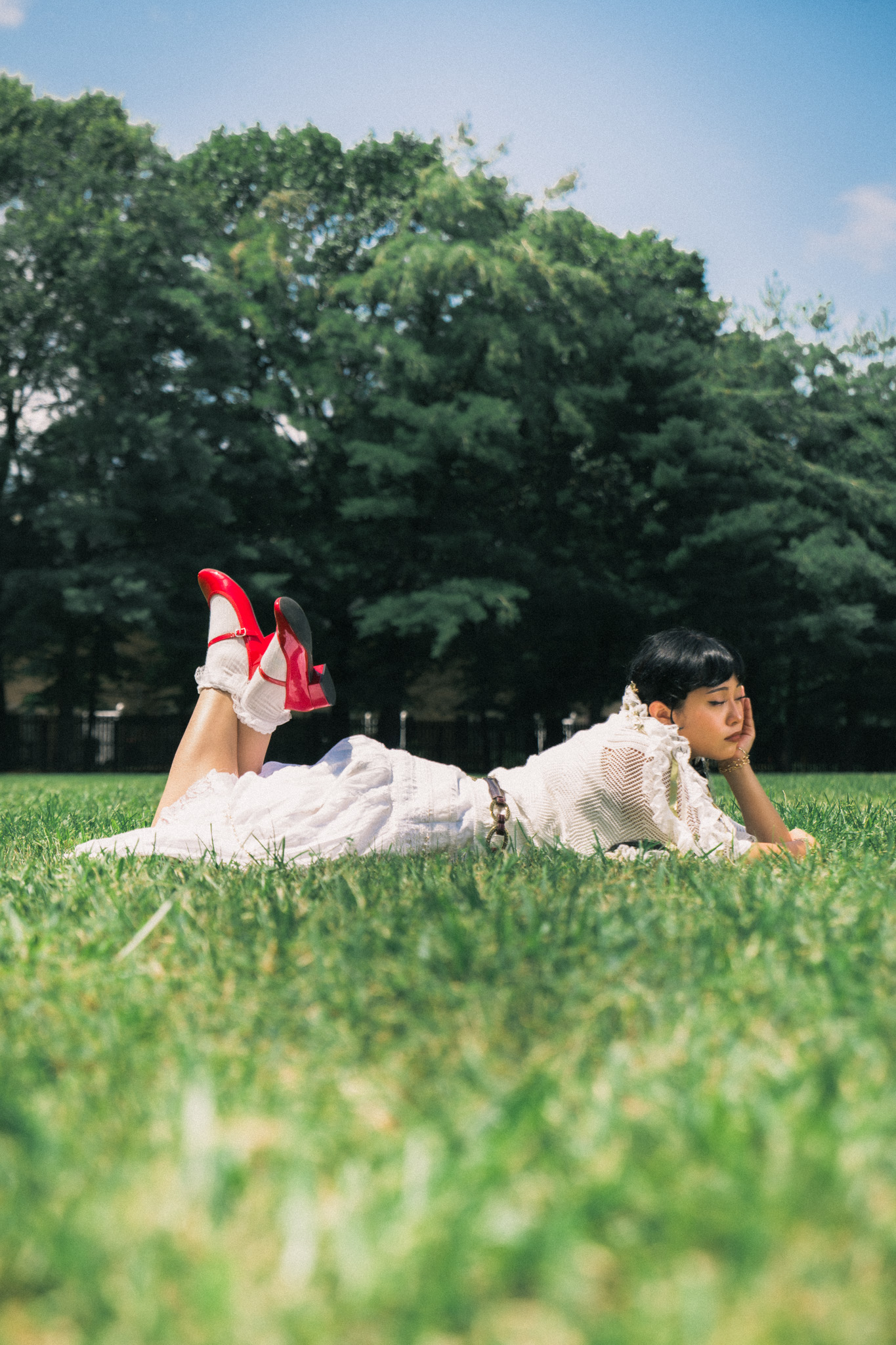
On her recently released album Nostalgia, Selines turns the tension of growing up bilingual into something you can feel in both languages.
There’s something about Selines that makes you want to lean in. The 21-year-old New York-based singer-songwriter released her second album Nostalgia and it arrives soft, folk-inspired and more emotionally layered within the Mexican-American perspective.
Vulnerability as Practice, Not Brand
“I try to keep it very authentic,” she tells me when asked how she’d describe her music to a first-time listener. “Very vulnerable. Very soft.” And she means it, not as a brand, but as a practice. Selines has been writing her feelings down since before she was writing songs. Journals, diary entries, a private record of everything she felt but couldn’t say out loud. When music entered the picture, she found something she didn’t expect: it was easier. “It was so much easier converting it into just songs,” she says. “My main thing was trying to replicate that sadness I felt, or that very happy day, into just music and the way I sing it.”
The Roots of Her Sound
She started playing guitar at seven, and that early intimacy with the instrument shaped everything. She points to folk artist Ed Maverick as a touchstone, someone who proved that the right lyrics could carry the full weight of a feeling. Natalia Lafourcade taught her how to weave poetry into song. Carla Morrison showed her what a thin, light voice could do to a room. Selines heard all of that and held onto it. The result is an album that sounds nothing like what’s dominating the 2020s, with no synthetic layers and no hyper-pop sheen. Just an acoustic guitar and a voice that doesn’t try to fill more space than it needs to.

Feeling in Two Languages
Nostalgia is also bilingual, and that’s where things get genuinely interesting. Selines grew up speaking Spanish at home and English everywhere else, and she spent years feeling the gap between those two versions of herself. “I feel way more in Spanish, if that makes sense,” she says. “The Spanish language has way more words to identify certain feelings with.” Yet she also remembers being that little girl who had to reach for English anyway, because the context demanded it, because her friends spoke it, because sometimes there was no other option. So she made an album about the space between those two worlds.
The Same Song, Two Worlds Apart
The proof is in the tracklist. She has a song called “lugares” and then another song also called, “places” written with the same title but in English. Not a translation, but rather the same feeling pulled through a different language. “They’re the same song,” she explains, “but it’s different the way you feel it in one language than it can be for the other one.” The Spanish version was written first, and when she finished it, it felt far from what she’d later write in English. She was okay with that. The distance was the point.

The Nostalgia of Growing Up
Distance runs all through this album, actually. The nostalgia Selines is reaching for isn’t about a person, it’s more personal than that. It’s about being 21 and feeling yourself pulling away from the place and people you’ve always known, wanting independence but also feeling the weight of a family that wants you to stay. “There was a lot of distance everywhere,” she says, “but not necessarily between a person or any actual relationship. It was just a lot of feelings all around.” Beyond that, she’s also wrestling with whether New York, the city she’s from, is actually the place she’s meant to stay.
Writing When the Wave Comes
Her songwriting process reflects all of this. She doesn’t write on a schedule. She waits for the wave. “I try to write music when I’m at a peak moment of emotions,” she says. Sometimes that means a month passes with nothing. Then a weekend comes, the week’s weight finally lands, and she’s ready. Lately she’s been experimenting with writing from emotion rather than personal experience, using the same feeling but not tethering it to her own life. It’s new territory for her, and she’s still figuring it out.
“Ay Amor!” and the Song That Found Its Sequel
Her song “ay amor!” caught on with listeners in a way she never expected. She wrote it at 19, not thinking about impact, just thinking about what she felt. The response surprised her. Over time, she sat with it, started trusting herself, and eventually wrote a sequel, “ay amor ii,” that picks up where the first song left off. The first song was written in happiness, in the glow of something new. The second one arrives after that something ends. She even included pieces of the first song inside it, like a thread running through both.
Making People Feel Less Alone
When I ask what she wants listeners to take away from Nostalgia, she doesn’t hesitate. “My overall message is just to let people know they’re not alone.” She talks about finding songs that made her feel like she wasn’t going crazy on her own, and how that’s the whole reason she puts music out at all. “If you find a song that resonates with you and you feel a little less lonely in what you’re feeling,” she says, “that’s the whole reason I write it.”
Selines is 21, still living at home, and already somewhere in between. Nostalgia sounds exactly like that, like someone standing in two doorways at once, looking back and forward at the same time, making something beautiful out of not quite knowing which way to go.

I am from Richmond, TX and currently studying communications at the University of Houston. I enjoy drinking peach oolong tea and attending concerts!
