


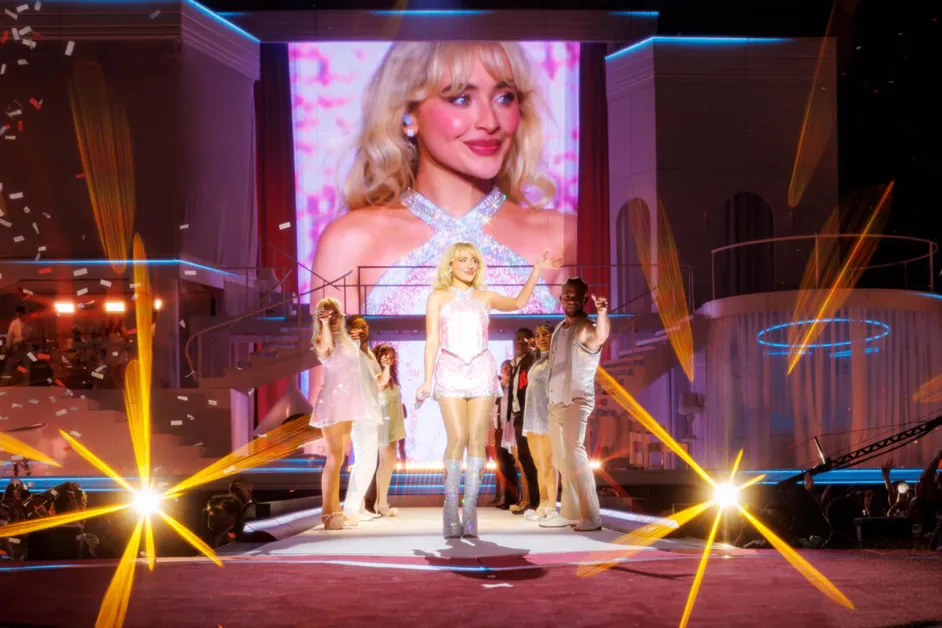
In an era of digitized touchpoints, artists turn to fuzzy handcuffs and tiktok dances to bridge the connection gap between artist and fans, marking a change in notions of artistic authenticity.
The 2025 awards season saw continued success for global pop stars Sabrina Carpenter and Charli XCX. Carpenter topped the Kids’ Choice Awards, won several Grammys, and snagged the VMA’s Album of the Year award for Short n’ Sweet. Similarly, XCX continued to gain mainstream success as Brat took home both Album of the Year and Artist of the Year at the Brit Awards.
Twelve acceptance speeches later, both artists maintained visibility throughout the rest of 2025 with highly memorable and culturally impactful live tours. Carpenter’s Short n’ Sweet Tour was the sixth highest-grossing pop tour of 2025, and XCX’s Brat Tour is the subject of an upcoming A24 mockumentary film releasing in early February. Both artists completed full festival runs and worldwide venue stops, totaling 70+ performances each.
While completely different in structure and style, both shows contained a midway moment of simulated spontaneous audience interaction. Carpenter performed a coquettish nightly bit of gifting pink handcuffs to an audience member, signifying a “sex-symbol” designation from Carpenter herself. Simultaneously, XCX repurposed a viral fan-made TikTok dance into a jumbotron-style spotlight on an audience member performing the “Apple” choreography.
Both traditions became certified publicity maneuvers, showcasing a mix of fans and celebrity guests. Carpenter’s “arrestees” included Nicole Kidman, Anne Hathaway, and Millie Bobby Brown—who admittedly asked to participate in Carpenter’s Atlanta tour stop—while “Apple” dancers included Chappell Roan, Ayo Edebiri, and Jenna Ortega.
Amidst the surge of A-lister guest stars, fans longed for fandom crossovers. “Sabrina has exactly 6 chances to Juno arrest Conan [Gray],” posted @Quotes24Random (Cheyenne). Several other 2025 tours implemented audience interaction bits, including An Evening with PinkPantheress, Role Model’s No Place Like Tour, and Conan Gray’s The Wishbone Pajama Tour [see: PinkPantheress’ “Romeo” dancers, Role Model’s “Sally” girls, and Conan Gray’s “Wishbone” breakers]. This proliferation of planned interactions demonstrated the desire for artist-to-artist community and artist-to-fan connection in contemporary music.
In the early 2000s, when emo and hip-hop prevailed, artist collaborations abounded—such as the now-defunct but still ubiquitous Young Money Entertainment “Big 3”: Nicki Minaj, Drake, and Lil Wayne; the now disreputable Roc Nation “Big 3”: Jay-Z, Rihanna, and Kanye West; and the “Fueled by Ramen Five”: The Academy Is…, Cobra Starship, Panic! At The Disco, Fall Out Boy, and Gym Class Heroes. These artist groups toured together, collaborated on releases, partied together, and represented a designated niche for fans.
The now fragmented, independently curated, and internet-based contemporary industry model creates an increased sense of individualism within fandoms. These contemporary cross-collaborations feel reminiscent of the early aughts’ artistic communities but lack the prior sense of genuine connection between musicians.
While some fans celebrated the guest appearances, others criticized the commercial nature of the trend. “I hope Charli never puts the Apple dance in her shows again, let’s remind people this song is so much more than a tiktok trend,” said @siegfriedkjs (dalia), wielding her pre-virality memories as an indicator of closeness to XCX’s original intent. Although counterproductive to creating listener communities, such displays of individual fan knowledge understandably express weariness towards the trendification of celebrity cross-pollinating.

Fan interactions have been a part of live shows for decades—artists like Green Day and Bruce Springsteen have previously implemented the foolproof “fan-sings-or-plays-guitar” schtick (see: this iconic Green Day “Knowledge” performance). However, the preconceived theatrics of Carpenter’s arrests and the social media posting potential of XCX’s “Apple” dances demonstrate a shift away from necessitated authenticity in live performance.
When rock was king, stripped-down authenticity was prioritized as the indicator of meaningful music, but pop introduces a sense of artificiality that acknowledges the production and manufacturing behind major tours. High-production tours like Madonna’s Girlie Show and Lady Gaga’s ARTPOP Ball necessitate a move away from correlating spontaneity with authenticity—the heartfelt, painstakingly considered messaging, imagery, and performance of such tours cannot be evaluated by their level of relatability.
Pop music acts as a melodrama, with performers displaying a feigned character more similar to film than folk. However, the feigned spontaneity of these 2025 tours neither curates genuine connection nor staged performance, but instead dies somewhere in the middle. Hopefully, with more performances from Madonna and Gaga on the way, “fan service” can remain in 2025.

I’m an writer and photographer currently studying Radio-TV-Film at the University of Texas at Austin. Some of my favorite artists are Arctic Monkeys, Faye Webster, and Doja Cat. I take photos and write with Austin Underground of TSTV, and I love creating media with local zines. In my free time, I like to cook, play pickleball, and have picnics with friends.
