


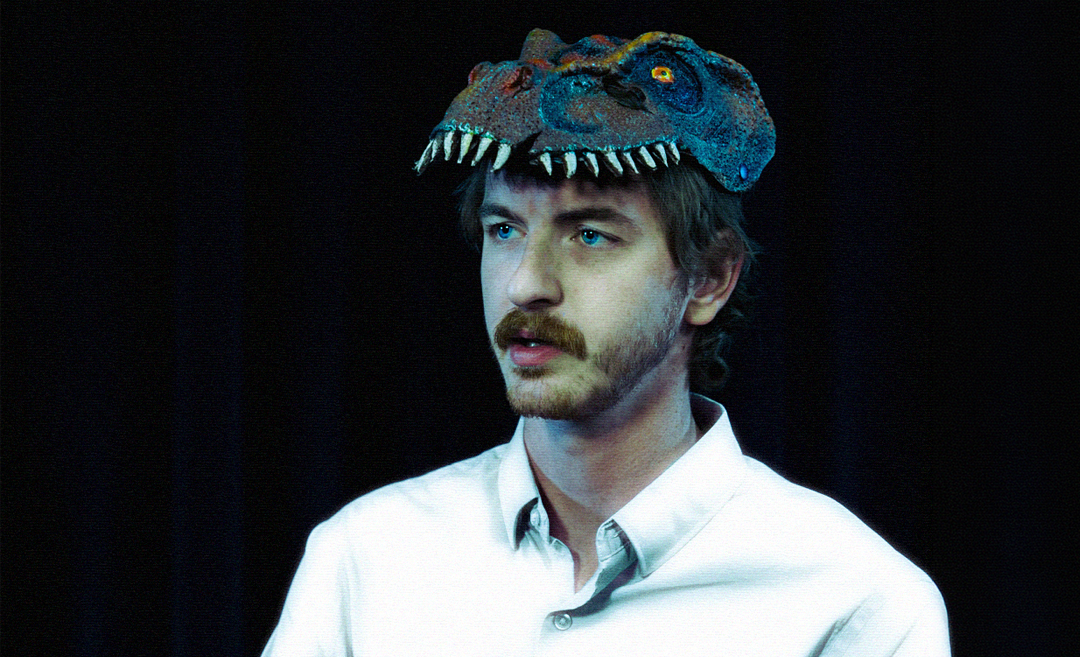
The first listen to Javelin by Hayes Howard only gives you part of the story.
The first thing I noticed about Hayes Howard‘s Javelin wasn’t a lyric. It was everything happening around it. Guitars appear and disappear. Small details hide in the background. Hayes’ vocals sit inside the songs instead of above them, sometimes making you work a little harder to understand what the story is. This only makes the album that much easier to connect with.
The first listen is about the feeling. You catch the melodies, the textures, and the strange little universe surrounding the record. Then you come back, pull up the lyrics, and realize there was another layer sitting underneath the whole time. You practically listen to Javelin twice.
Hayes says his writing process usually starts with a guitar part, followed by a vocal melody. The lyrics come later, and sometimes a little bit of the original gibberish makes it into the final song because it fits. That approach feels present throughout the album. The songs don’t feel like they were built around explaining themselves. They leave room for the listener to find their own way through them.


Before making Javelin, Hayes spent years helping other artists shape their own music, including engineering Derby’s Slugger. That experience taught him how to listen closely, but this album is where that attention is focused entirely on his own work. When Hayes talks about Javelin, he rarely starts with himself. He talks about the people around him, the songs that influenced him, and the small choices that shaped the record.
Even as a debut full-length, Javelin never feels like an introduction. It feels like walking into something that was already happening.
The imagery alone makes that clear.
Cavemen. Track meets. Dinosaurs. Roller coasters. Retro games.
None of those ideas seem like they should belong together. Somehow, they do.
Hayes describes the album as being about wanting to get somewhere, but having to return to the beginning before moving forward. That idea connects the different pieces of Javelin, from the artwork to the songs themselves. The record is full of moments that seem separate at first, then reveal how closely they are connected.
Hayes points to “Bricky” as the song where the idea behind Javelin finally clicked.
“I had a vague idea of the world I was going for,” he says. “That song was sort of an aha moment.”
It makes sense why.
“Bricky” feels like one of the clearest examples of what makes the album work. It doesn’t give you a simple answer. It sits in uncertainty.
“Does it happen like that to you too?”
The question hangs there.


That feeling appears throughout Javelin. Hayes isn’t trying to make every emotion obvious. A lot of the album lives somewhere between confusion and understanding.
That might be why every track feels so separate. A lot of albums have songs that blend together. After a while, you start checking the title because you’re not sure which track you’re hearing. That doesn’t happen here.
“Bricky,” “Green Golden,” “Cherry,” and “ICEFLAGS” all have their own identities. They don’t sound like different versions of the same song.
The easiest way to describe it is that Javelin feels like one big family. Each song has its own personality, but they still belong together.
That variety comes from the way Hayes approaches making music. His background as an engineer is obvious, but it never takes away from the emotion of the record.
“The better you know something, the more ways you get to appreciate it,” Hayes says.
That mindset shows up in the small details.
On “Nock,” Hayes recorded an acoustic guitar one string at a time, creating what he describes as a “big music box.” It is the kind of production choice most listeners would never notice unless they were looking for it. Once you know it’s there, though, you start hearing the song differently.
The production choices on Javelin aren’t there just to show what Hayes can do. They give each song more character.
“Green Golden” was one of the tracks I kept coming back to. There is a constant push and pull throughout the song. “Hold your ground, find your balance.”
Then there is “ICEFLAGS.”
The song might be one of the best examples of why Javelin rewards another listen. It is emotional without spelling everything out. The lyrics feel distant and close at the same time.
“It’s unfair / Take me back there.”
Hayes lets those moments exist without forcing a clear explanation. That same approach appears all over the album.
The story behind Javelin is also tied to the people around Hayes. Friends. Family. Collaborators. When he talks about finishing the album, he credits them.
“I honestly don’t know if or when it would’ve come out if it weren’t for them,” he says.
That support is part of the record’s identity. Javelin may have Hayes Howard’s name on the cover, but it carries the influence of the people who helped him get there.
Hayes plans to bring Javelin to a live audience with his band soon.
When asked what success would look like without streaming numbers or recognition, his answer was simple.
“The success is always gonna be the fact the album exists at all.”
That might be the best way to understand Javelin. It isn’t an album built around getting everything right on the first listen. It is built around discovery. The first listen gives you the feeling, the second gives you the story, and the third gives you the atmosphere. Somewhere along the way, you realize you’ve gotten lost in Hayes Howard’s world.


I'm an Austin-based photographer and filmmaker. I'm a mother of two (cats) and I love picking up expensive hobbies to spend all of my money on, whether that be tattoos, vinyl, or concerts. My top three artists are Dijon, Mk.gee, and Dominic Fike. I love to travel and learn new ways to fulfill myself creatively. My biggest aspiration is to find the most imaginative way to seamlessly combine my 3 favorite things: film, photography, and music.
